Architecture in depth
- Global Contexts
- Heterogeneous Compute
- Ephemeral Compute
- Whiteboards & Dataflow
- LLM Connections (new in v2.2)
- Builders & Supervisor (new in v2.2)
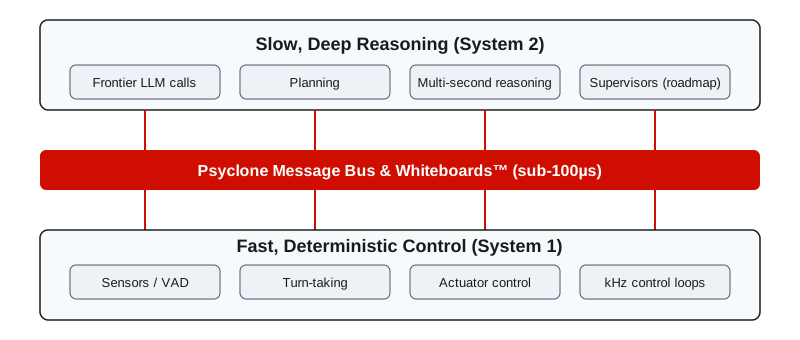
Psyclone AIOS™ is a real-time AI operating system, built on over two decades of research into large-scale, distributed AI systems. It’s the runtime underneath CMLabs’ Sub-Millisecond AI category — the layer that lets slow, powerful reasoning (LLMs, planners) coordinate with fast, deterministic control (sensors, actuators, conversation) inside a single system.
The problem it solves
Frontier LLMs reason well but are slow — chaining them together via standard API orchestration introduces 500ms+ of lag, cost, and fragility. Human conversation needs 300–500ms turn-taking. Physical and industrial control loops need kilohertz timing. Standard orchestration layers can’t do both at once. Psyclone can.
For a business reader, the point is simple: if your product involves AI interacting with people or machines in real time — voice assistants that don’t talk over their users, robots that react before it matters, industrial systems that can’t afford to wait for a cloud round-trip — the bottleneck is rarely the AI model itself. It’s the plumbing between components. Psyclone is that plumbing, engineered to real-time standards, and it has been running in commercial and research deployments for years. See why sub-millisecond matters and where it’s been proven in the field.
How it works — the architecture
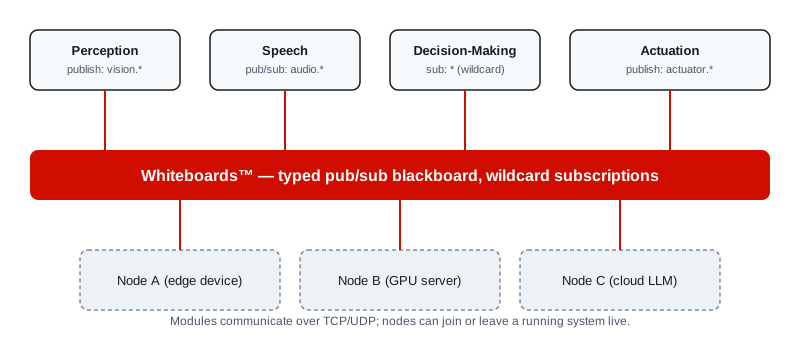
Psyclone is a publish-subscribe blackboard architecture. A running system is a set of independent modules — perception, decision-making, speech, actuation, anything — that never call each other directly. Instead they post typed messages to shared Whiteboards™, and subscribe to the message types they care about, with wildcard patterns for flexible matching. The result is a system with no hard-wired call graph: modules can be added, removed, restarted, or moved to another machine while the rest of the system keeps running.
- Sub-100μs messaging: the core message path is engineered for sub-100 microsecond delivery. That’s not a benchmark trophy — it’s the property that lets a single runtime carry both kilohertz control traffic and slow LLM responses on the same bus without the fast side ever waiting on the slow side. Message routing, dispatch, and memory handling are all built in C++ with real-time behaviour as a design constraint, not an optimisation applied afterwards.
- Whiteboards™ — pub/sub with memory: unlike a plain message queue, a Whiteboard is also a blackboard: posted messages persist and can be queried, so modules can reason over recent history rather than only reacting to a live stream. Typed messages and wildcard subscriptions mean routing logic lives in declarative subscriptions, not scattered through application code.
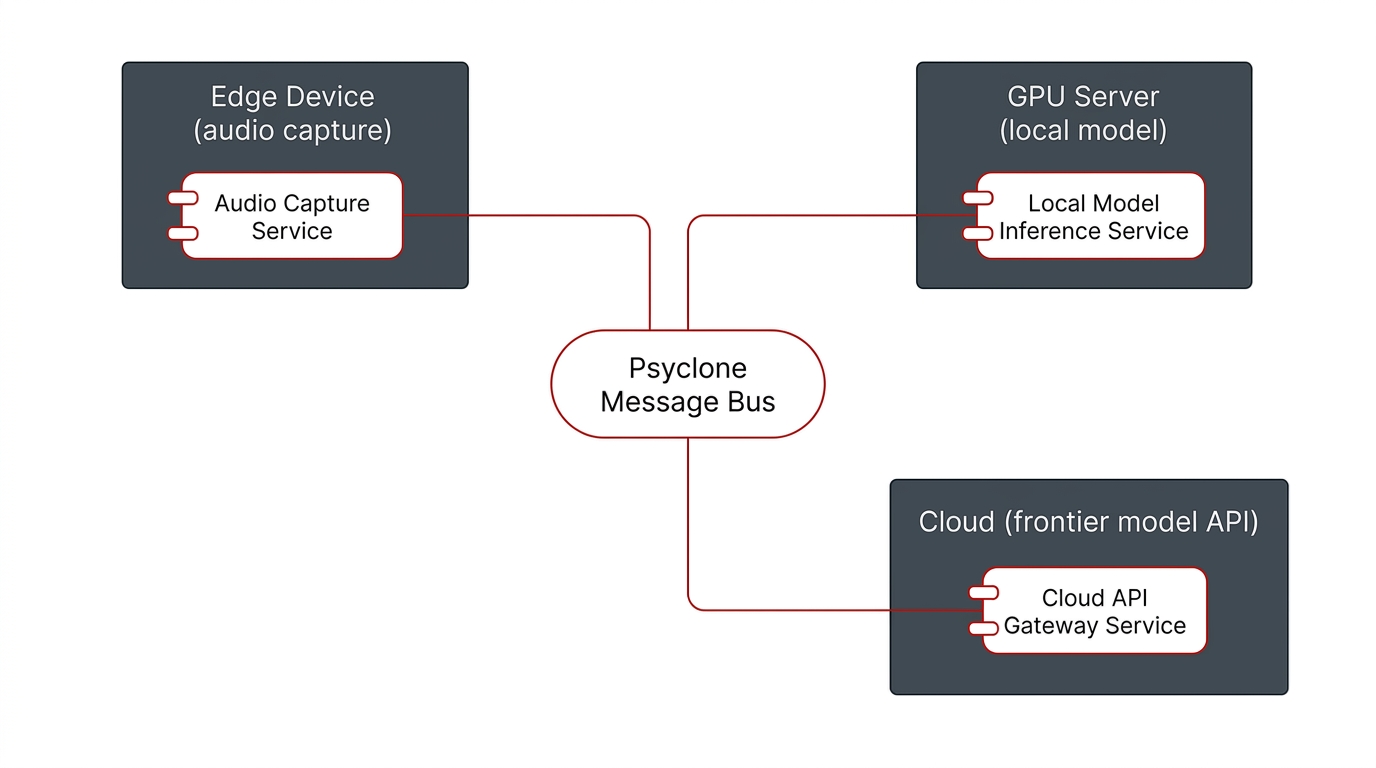
- Distributed by design: a Psyclone system spans machines natively, over TCP and UDP. Whether modules run in one process, on one machine, or across a server farm is a deployment decision, not an architecture change — the messaging semantics are identical. Scale out by moving heavy modules (vision, LLM gateways) to bigger hardware while latency-critical modules stay close to the metal.
- Hierarchical contexts: system behaviour is organised into activation contexts that switch which modules and subscriptions are live. This gives you dynamic sequencing and mode-switching — startup, normal operation, error recovery, task phases — without hard-coding control flow into the modules themselves.
- C++ core, multi-language modules: the runtime is written entirely in C++ and compiles on Windows and Linux. Modules can be written in C++, Python, or Java against a common message protocol — Python integration has been part of the platform since Psyclone 2.0, so fast-moving AI/ML code in Python coexists with hard-real-time C++ modules on the same bus. The component SDK (CMSDK) is a separate, BSD-licensed library.
- Built to stay up: because modules are isolated and communicate only via messages, a misbehaving module doesn’t take the system down — it can be restarted or replaced while everything else keeps running. This is the operational discipline learned from years of real-world deployments in robotics and industrial settings, where “restart the whole stack” is not an acceptable failure mode.
- Live introspection (PsyProbe): a built-in web-based monitor lets you inspect message flows, module state, and system health on a running production system — and intervene — without downtime. When something goes wrong at 2am, you look inside the live system instead of reproducing it in a lab.
How it differs from agent frameworks
Most current AI orchestration frameworks (LangChain-style chains, agent graphs, workflow engines) are request/response pipelines: call a model, parse the output, call the next thing. That works for offline tasks. It breaks down when the system has to live in real time — when a robot arm, a microphone, and an LLM all have opinions at once, on different timescales.
Psyclone inverts the model. There is no chain. Everything is a concurrent module on a deterministic, low-latency bus; slow reasoning and fast reaction run side by side, and the fast path never blocks on the slow one. Timing is a first-class engineering property of the runtime, not an emergent side effect of whichever API happens to respond slowly today. That is the difference between an orchestration script and an operating system — and it’s why Psyclone predates, and outlasts, framework churn: the architecture comes from over two decades of building distributed AI systems that had to work, in the field, in real time.
Where it’s used today
Psyclone runs production and research systems in real-time voice AI and conversational agents (keeping natural human turn-taking intact against laggy LLM pipelines), and has powered EU-funded human-robot collaboration research and commercial deployments in automotive, robotics manufacturing, and facial recognition. See the full track record.
Documentation
For the full technical reference, read the Psyclone Platform System documentation (87 pages), and the CMSDK API documentation for component development.
Get Psyclone
Psyclone is available two ways, both directly downloadable:
- Binary distribution: pre-built Psyclone binaries for Windows (32/64-bit) and Linux — download from the Download page.
- Open source: the complete Psyclone source distribution (C++, includes CMSDK), plus the standalone CMSDK SDK for building your own Psyclone components — also on the Download page.
Licensing: Psyclone is released under LGPL and CMSDK under BSD; both include the CADIA Clause, which restricts harmful use. Commercial licensing with support is also available. Full terms on the Licensing page.